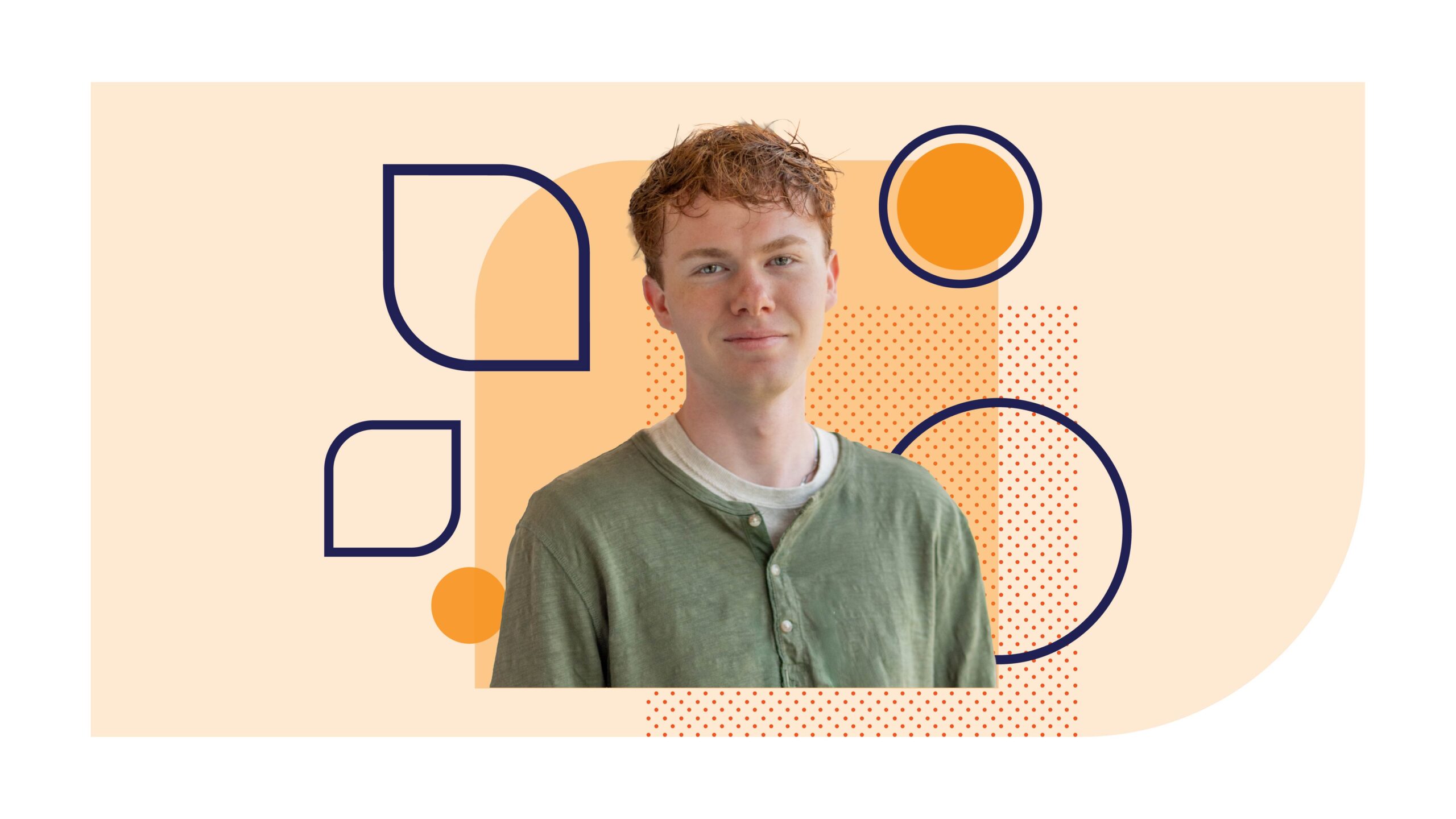

Flintern Spotlight: Tyler Halstenson
By Lydia Picotte, Creative Writing Intern – Flint Group
A 3D rendering of a pink pill bottle sits open on a computer monitor. With one click, Tyler Halstenson spins the creation around, trying to determine his next move. A rising junior at NDSU, Flint Group’s design intern is never without a new skill to be mastered, and this position has presented him with his latest creative challenge – digital advertising.
For Halstenson, an internship is an opportunity to learn about the professional applications of his art.
“I really like NDSU for the art program, but agency life is different,” he argues. “Advertising is something I don’t touch in class. So, coming to Flint, I knew that I would learn things. I wanted real world experience school isn’t giving me.”
In the age of AI, this experience is more important than ever.
As AI image generators have become increasingly accessible in recent years, the novelty of machine-generated art has taken over creative spaces around the world. This month, the world’s first AI art museum opened in Los Angeles.
This reality weighs on the mind of Halstenson, who hopes to remain original in the evolving creative world.
“Now I’m thinking ‘everything has been done,’” he remarks. “How do I make something of my own? AI can make anything now. How do I be more important than that?”
What he humbly omits is that he’s already an award-winning advertiser. This spring at NDSU, Halstenson and fellow Flintern Emma Rehder contributed to a poster campaign that won them national recognition from the American Advertising Awards.
Still, Flint’s professional training is exciting for the designer. Until now, he’s been largely self-taught.
“With graphic design, I watch YouTube videos on my own about it,” says Halstenson. “Or else I sit and experiment by myself.”
This inherent drive, the urge to learn for the sake of learning, is a key part of Halstenson’s identity as an artist. He describes how easily he can lose hours in the studio, mastering the details of a certain medium.
“I’m just so technical – like a perfectionist of everything,” he explains.
Eavesdropping from another corner of the office, Rehder rolls her eyes and removes her headphones to interject that even “perfectionist” is a healthy understatement.
Halstenson recalls making 30 iterations of a print for an art show until he had one he deemed good enough for display.
While his entrance into the world of advertising is relatively recent, creating is nothing new for him. Art has always been his primary guiding force.
“I try to remember what else I was going to go into my senior year of high school, but I just knew I liked art,” says Halstenson. “I knew I would figure it out.”
He’s now earning his BFA and an art education degree, and minoring in strategic communications. In an ironic juxtaposition to the digital graphic designs that he works with at Flint, Halstenson’s preferred mediums are more tangible.
Dubbed an “object maker” by one professor, Halstenson’s favorite pieces are the ones that he can feel. Some of his past concentrations include printmaking, creating cyanotypes (a method of printmaking that uses UV exposure to reveal images) and bookmaking.
His favorite object – a piece of concrete printed with a cyanotype of the hospital where his dog died – illustrates the power of his material pieces. The physical weight of the rock mirrors the emotional weight that Halstenson carries from the memory.
The ability to find meaning in his art is a large part of his current focus as an artist.
He credits one of his art professors for pushing him to not only create things that look pretty but reflect on how they connect to his emotions – to identify what they mean beyond how they look.
He’s found that the best way to humanize his work is to observe the humanity in the world around him. Take it. Use it. For this reason, Halstenson is never without inspiration. In his eyes, art is everywhere.
“I have a folder on my phone of pictures I take for inspiration and it’s just the most random things,” he admits. He also cites history and the local art scene as easy places to draw creative energy from.
He hopes the insertion of his lived experience will not only enhance the quality of his work but also make it more difficult for a machine to replicate.
Ultimately, his relationship with the community isn’t one-sided. It’s cyclical. The same spaces that inspire him are the ones he hopes to give back to in the future.
“The art community inspires me a lot,” he asserts. “Really more than any certain industry I just want to be creating for the community.”